Keller & North Texas Community News
Texas Data Centers Are Moving Into North Texas Neighborhoods: What Keller Homeowners Should Know
Glenn Wegner | Lone Star Realty
Published
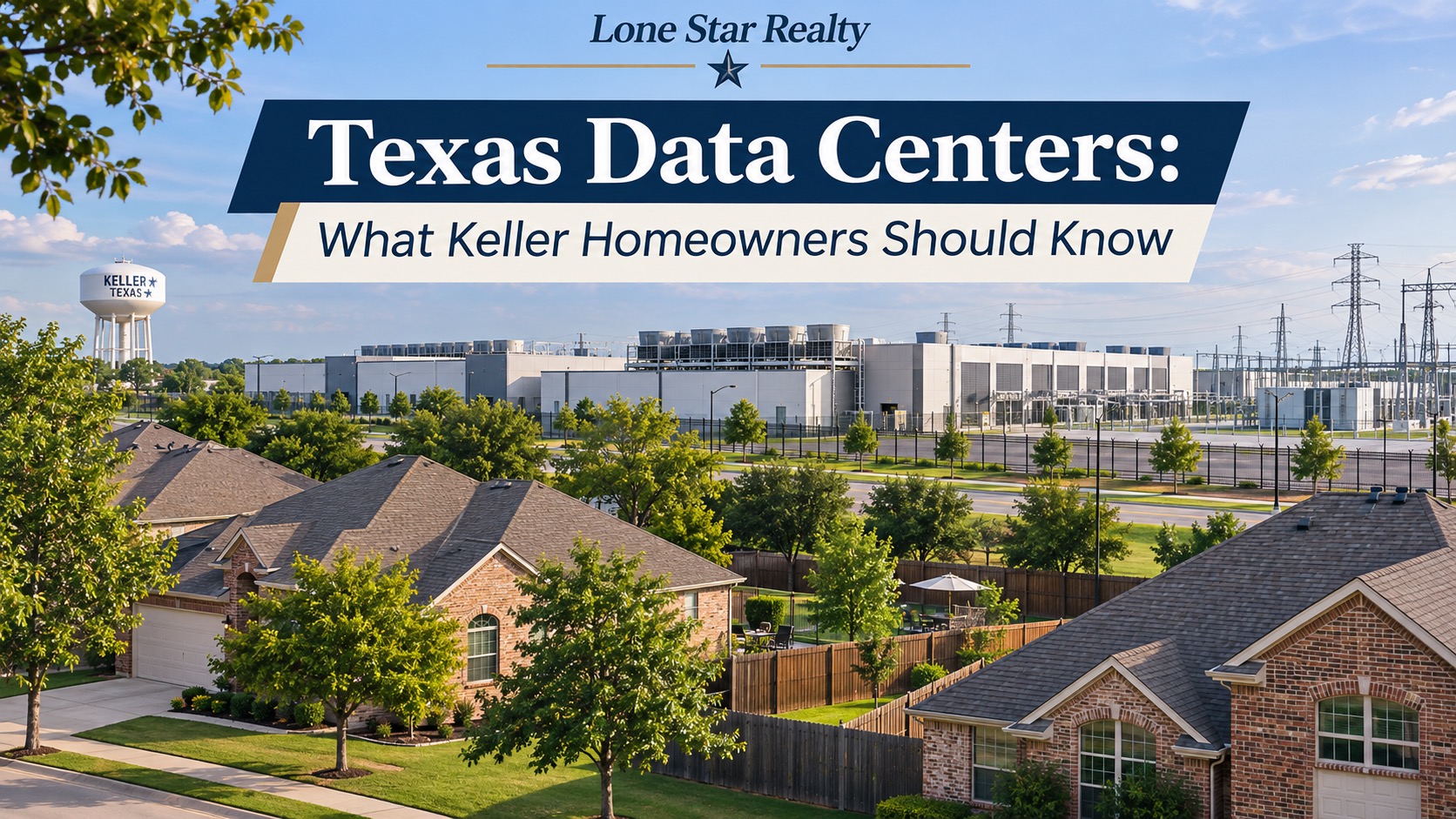
Featured image is used for illustration only; it is not a verified photograph or site plan of the proposed Westlake development.
Lone Star Realty | Local Area Insights | November 9, 2026
Why are data centers expanding so rapidly across Texas, and what could these massive developments mean for nearby homeowners?
Texas is becoming a major destination for data centers because of growing demand for artificial intelligence, cloud computing, and digital services. While these facilities support economic development, their proximity to residential neighborhoods has raised questions about noise, electricity, water consumption, land use, and property values—particularly in Keller and surrounding North Texas communities.
Why Are So Many Data Centers Being Built in Texas?
If you've driven around North Texas recently, you may have noticed enormous industrial buildings, electrical substations, extensive security systems, or construction projects that look different from traditional commercial developments.
Some of these facilities are data centers.
A data center houses the computer servers and supporting equipment needed to process, store, and transmit enormous amounts of digital information.
Every time you use cloud-based software, stream entertainment, make an online transaction, or interact with artificial intelligence, data centers help support the technology behind those services.
Texas has become attractive to data center developers because of its large land market, established technology infrastructure, business environment, and access to electrical resources.
The Texas Comptroller reported that the Dallas–Fort Worth region had approximately 141 data centers in its 2024 industry analysis, making it one of the country's largest data center markets. Texas Comptroller
And the demand for electricity is growing.
According to a 2026 Lawrence Berkeley National Laboratory report, U.S. data centers could account for approximately 9.5% to 15.3% of the nation's electricity consumption by 2030.
These are projections, not guaranteed outcomes, but they illustrate the scale of the industry's expected expansion. LBL ETA Publications
The Keller–Westlake Data Center Controversy
For Keller residents, this issue is not theoretical.
In 2026, a proposed data center in neighboring Westlake generated considerable concern, particularly among homeowners in Keller's Marshall Ridge neighborhood.
According to the City of Keller, the proposed facility would encompass approximately 1.1 million square feet, with the development located roughly 506 feet from some Keller backyards.
Residents raised concerns about noise, environmental effects, potential impacts on property values, and whether neighboring homeowners had sufficient opportunities to participate in the approval process.
Westlake officials maintained that the development met applicable requirements and described planned measures to limit its impact.
The proposal illustrates a difficult issue: A development approved in one city can directly affect residents living across a municipal boundary.
November 2026 Update: Keller and Westlake Reach an Agreement
On November 5, FOX 4 reported that Keller, Westlake, and Circle T Owner LP had reached an agreement resolving litigation surrounding the proposed development.
According to that report, the agreement includes:
- Enforceable noise protections for Keller.
- Quarterly noise monitoring during the first three years of operation.
- Landscaping requirements.
- Emissions controls.
- A financial contribution to Keller Fire-Rescue. The agreement is an important development, but it does not demonstrate that the facility will have no effects on neighboring properties. Actual performance must be evaluated after construction and operation. Fox 4 News
For the latest official documents and updates, visit the City of Keller's Westlake Data Center information page.
What Concerns Are Homeowners Raising About Data Centers?
When a large data center is proposed near an established residential neighborhood, residents frequently want answers about several issues.
1. Continuous Equipment Noise
Unlike a conventional office building, a data center operates continuously.
Cooling equipment, ventilation systems, transformers, and other infrastructure can generate persistent noise. Backup generators can also create significant noise during testing or operation.
The concern isn't necessarily a single loud event. It may be a continuous mechanical hum or low-frequency sound that changes the experience of nearby outdoor spaces.
The actual effect depends on equipment design, distance, terrain, sound barriers, and operating practices.
For homeowners, the most useful evidence includes documented sound studies, enforceable limits, and independent monitoring rather than general assurances that a facility will be quiet.
2. Electricity Demand and Grid Infrastructure
Large data centers consume substantial amounts of electricity.
Texas lawmakers responded to growing large-load demand with Senate Bill 6, effective June 20, 2025.
The law addresses interconnection requirements, grid reliability, and how certain infrastructure costs are allocated for large electricity users. capitol.texas.gov
This does not mean every new data center automatically increases nearby homeowners' electricity bills.
It does mean residents have legitimate reasons to ask what new substations, transmission improvements, or electrical infrastructure may be required and how those costs will be recovered.
3. Water Consumption
Water demand varies significantly depending on the facility's cooling technology.
Some data centers use evaporative cooling systems, while others employ closed-loop or alternative cooling configurations.
Texas Tribune reporting has highlighted uncertainty surrounding how much water future Texas data centers will require. The Texas Tribune
When evaluating a proposed project, homeowners should ask for its projected annual water use, peak demand, supply source, and cooling technology.
4. Lighting, Construction, and Visual Impact
Large data center developments can involve expansive buildings, fencing, security lighting, electrical substations, and substantial mechanical infrastructure.
Construction may also generate temporary traffic, dust, and noise.
The effects depend heavily on site design and the proximity of neighboring properties.
Landscape buffers, lighting controls, setbacks, and construction-hour restrictions can help address these concerns, but their effectiveness should be evaluated for each project.
Could a Nearby Data Center Affect Your Home's Property Value?
This is one of the most important questions for Keller homeowners.
The presence of a nearby data center does not automatically mean your property will lose value.
Property values depend on numerous factors, including location, condition, comparable sales, housing supply, and buyer demand.
However, if a facility creates noticeable noise, changes surrounding views, or affects the use of adjacent outdoor spaces, some prospective buyers may consider those conditions when evaluating a home.
The actual market effect must be established through sales evidence.
A professional property valuation should examine comparable transactions, proximity to the development, and documented differences between properties rather than applying an arbitrary percentage discount.
For example, comparing homes directly adjacent to a facility with otherwise similar homes farther away may eventually reveal whether buyers are responding differently to the location.
But without reliable comparable sales, any claimed 5%, 10%, or 20% reduction would be speculation.
That's why homeowners should be cautious about dramatic property-value predictions made before a facility becomes operational.
What Is Fort Worth Doing About Data Center Development?
Keller and Westlake aren't the only North Texas communities confronting these questions.
Fort Worth has been evaluating its regulations for large data center developments, including land use, electricity, water, noise, and neighborhood buffering.
In August 2026, the city initiated a process to consider a 90-day moratorium and established a Data Center & Infrastructure Commission.
The city's published proposals include residential landscape buffers, restrictions on backup generator testing, and pre-development noise study requirements.
As of November 9, the city has scheduled commission-related proceedings and a moratorium hearing for November 10. Those actions should not be confused with a final, adopted citywide ban.
You can review the proposals and ongoing process on the City of Fort Worth Data Centers information page. Fort Worth Texas
What Should You Do if a Data Center Is Proposed Near Your Home?
If you're a homeowner in Keller, North Fort Worth, or another nearby community, you don't have to rely on rumors or social media discussions to understand a proposed development.
Begin with the public record.
- Identify the responsible jurisdiction. Determine which city or county has authority over the property.
- Review zoning and development applications. Look for site plans, building heights, setbacks, substations, and mechanical equipment locations.
- Ask for noise and infrastructure studies. Request measurable figures and monitoring requirements.
- Attend public meetings. Find out what approvals have already occurred and which decisions remain pending.
- Document existing property conditions. Preserve photographs, relevant public records, and any professionally obtained noise measurements.
- Understand the real estate implications. If you're considering selling, obtain a property-specific market analysis rather than assuming the development has changed your home's value. These steps help you replace uncertainty with documented information.
What Should Homebuyers Consider Before Purchasing Near Undeveloped Land?
If you're shopping for a home in Keller or elsewhere in DFW, nearby vacant acreage deserves attention.
A wooded tract or open field may appear permanent, but its future use depends on ownership, zoning, development agreements, and applicable land-use restrictions.
Before buying, consider researching:
- Current zoning and permitted uses.
- Pending rezoning applications.
- Approved development plans.
- Proposed roads, utility corridors, or substations.
- Nearby industrial or commercial development proposals. No amount of research can guarantee what will happen to neighboring property years into the future.
However, understanding existing plans can help you make a more informed purchasing decision.
The Bigger Picture: Economic Growth and Residential Quality of Life
Data centers are a significant part of the modern economy, and their development can bring investment, construction activity, and commercial tax revenue.
Communities also have legitimate interests in protecting residential property enjoyment, managing resource demands, and ensuring that development obligations are enforceable.
These interests don't have to be mutually exclusive.
The more productive question is not simply whether Texas should allow data centers.
It's where large facilities belong, what standards should govern them, and how neighboring property owners can obtain reliable information about their potential impacts.
Final Takeaway: What Texas Data Center Growth Means for Keller Homeowners
Texas data centers are expanding because the digital economy requires enormous computing capacity. But as these facilities approach established neighborhoods, the conversation increasingly involves property rights, land-use decisions, infrastructure, and real estate values.
The Keller–Westlake controversy demonstrates why residents should review development proposals early and why municipalities need clear, enforceable standards.
For homeowners, buyers, and sellers, the best response is to evaluate documented facts rather than assume every development will produce either economic benefits or financial harm.
Questions About Your Keller Home's Value or a Nearby Development?
If you're considering buying or selling in Keller, Southlake, Westlake, North Fort Worth, or surrounding communities, understanding nearby development activity is part of making an informed real estate decision.
As Broker/Owner of Lone Star Realty, I can help you review relevant property characteristics, recent comparable sales, and the market conditions affecting your home.
Glenn Wegner | Broker/Owner Lone Star Realty — Keller, Texas Phone: 682-888-5540 Email: Glenn@LoneStarReal.com Website: LoneStarReal.com
Local development information is current as of November 9, 2026. Plans, regulations, litigation, and construction status are subject to change.
Sources
- City of Keller — Westlake Data Center Updates
- FOX 4 — November 5, 2026 Settlement
- City of Fort Worth — Data Center Regulations
- Texas Comptroller — Energy Demand and Data Centers
- Lawrence Berkeley National Laboratory — Data Center Electricity Research
- Texas Tribune — Data Center Water Demand
- Texas Legislature Online — Senate Bill 6 history